



Quick Answer: Can You Use Spotify in Ableton Live?
Directly linking Spotify to Ableton Live is not officially supported due to Spotify’s DRM (Digital Rights Management) protection. However, you can still use Spotify tracks in Ableton through two proven methods:
- Method 1: Use Virtual Audio Cables (like VB-Cable or BlackHole) to route and record system audio in real-time.
- Method 2: Use a dedicated Spotify Music Converter (like AudKit) to download the tracks as local DRM-free files (MP3/WAV) and import them directly into your Ableton Live set.
Creating a raving fanbase as a DJ or producer is not entirely dependent on your skills, but also on your choice of tools. If you are kick-starting your DJing career or exploring music production, Ableton Live should definitely be on your must-have software list.
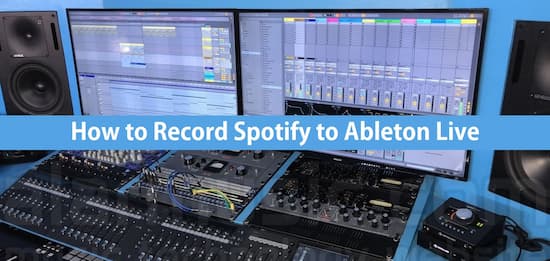
Ableton Live is a powerhouse Digital Audio Workstation (DAW) for Mac and Windows. Unlike traditional DJing software, it offers unparalleled flexibility for composing, recording, mixing, and mastering live performances. Since online streaming platforms are now the primary source of music, you might be wondering: Is it possible to link Spotify directly to Ableton Live?
Unfortunately, there is no official integration. Spotify encrypts its streaming content with strict DRM policies to protect artists’ copyrights, preventing unauthorized playback or sampling on third-party platforms like Ableton. But don’t worry—there are highly effective workarounds to get the job done.
- Part 1. How to Record Spotify to Ableton via Virtual Audio Cables (Real-Time)
- Part 2. How to Record from Spotify to Ableton
- Part 3. Import Spotify Songs to Ableton: Step by Step
- Part 4. Conclusion
Part 1. How to Record Spotify to Ableton via Virtual Audio Cables (Real-Time)
If your literal goal is to “record” the audio playing from the Spotify app directly into Ableton, you can use a Virtual Audio Cable software. This creates a digital bridge between your computer’s audio output and Ableton’s audio input.
- For Mac Users: Download and install BlackHole or Soundflower.
- For Windows Users: Download and install VB-Audio Virtual Cable or Voicemeeter.
How it works: You set your computer’s system audio output to the Virtual Cable, and then select that same Virtual Cable as the input device in Ableton Live’s Audio Preferences. Create an audio track in Ableton, hit record, and play the song on Spotify.
The Downside: While this method is free, it has severe limitations. Recording is done in real-time (a 4-minute song takes 4 minutes to record), you might suffer from slight audio quality loss, and any random system notifications (like an email ping) will be recorded over your track.
Part 2. How to Record from Spotify to Ableton
To avoid the hassle of real-time recording and audio quality loss, the most efficient method is to use a third-party tool to download the tracks locally. We highly recommend the AudKit Spotify Music Converter.
This professional software bypasses the copy-protection format smoothly and legally for personal use, allowing you to convert Spotify tracks, playlists, and albums into universal audio formats like MP3, AAC, M4A, WAV, or FLAC. Once downloaded, you can simply drag and drop the files into Ableton Live.
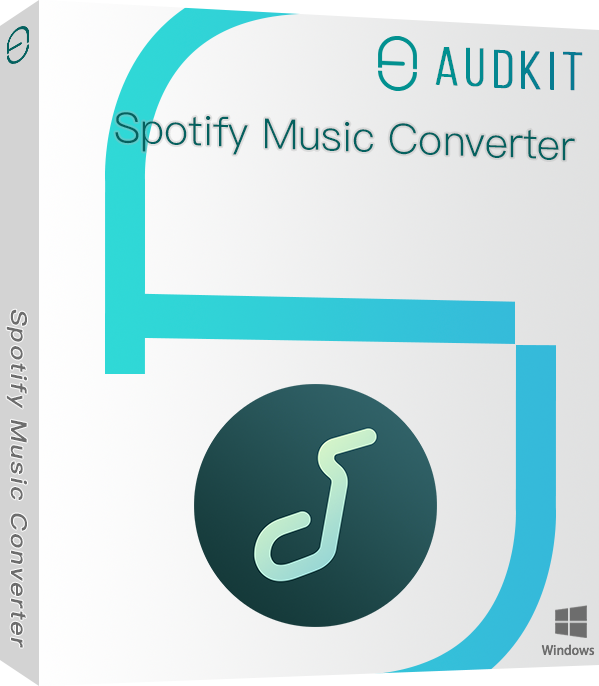
Main Features of AudKit Spotify Music Converter
- Retains 100% lossless sound quality and ID3 tags
- Supports batch download Spotify songs to MP3
- Customize output settings for multi-devices
- Work at 5X faster conversion speed
Here is a step-by-step guide on how to record from Spotify to Ableton using AudKit Spotify Music Converter.
Part 3. Import Spotify Songs to Ableton: Step by Step
First, download and install AudKit Spotify Music Converter on your PC or Mac. Launch the software (your Spotify app will open automatically alongside it) and follow these simple steps:
Step 1 Add Songs, Albums, Playlists from Spotify
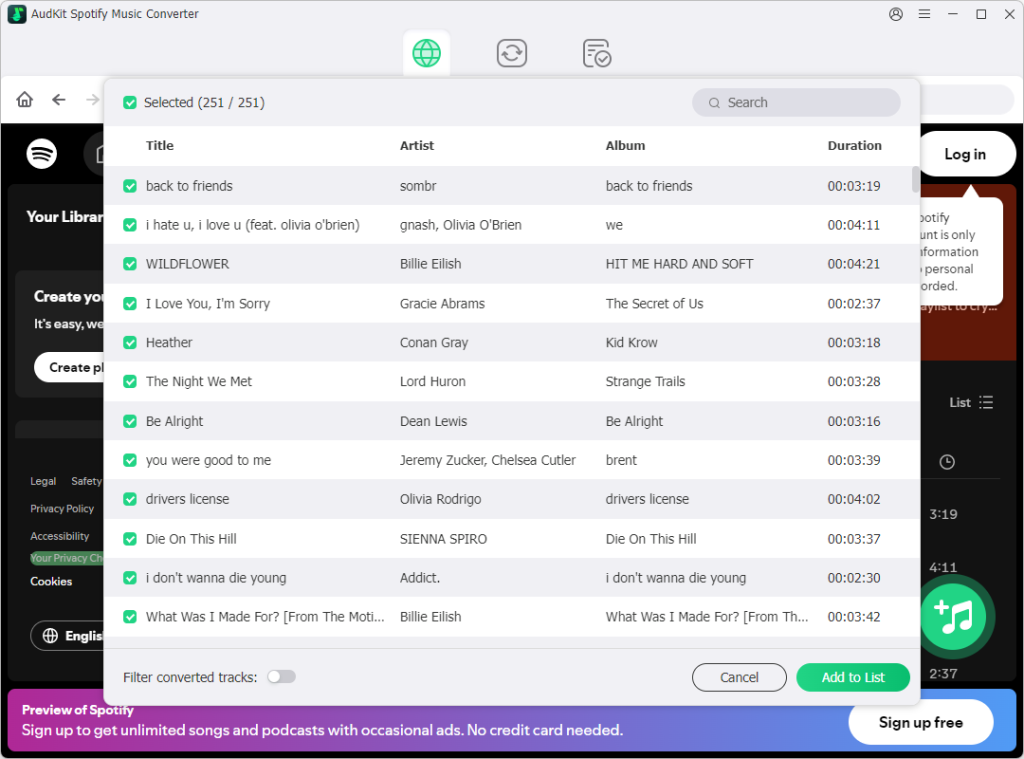
Start your Spotify app, Login to your account. Browse and select your preferred songs, albums, tracks on Spotify. Go on to drag and drop the selected songs onto AudKit’s main interface. Alternatively, you can right-click on the selected song and click on “Share” and then “Copy Song Link.” Proceed to paste the link onto AudKit’s search and hit the “+” tab to import it. You will have to repeat this for each song you select.
Step 2 Customize output format and audio parameters
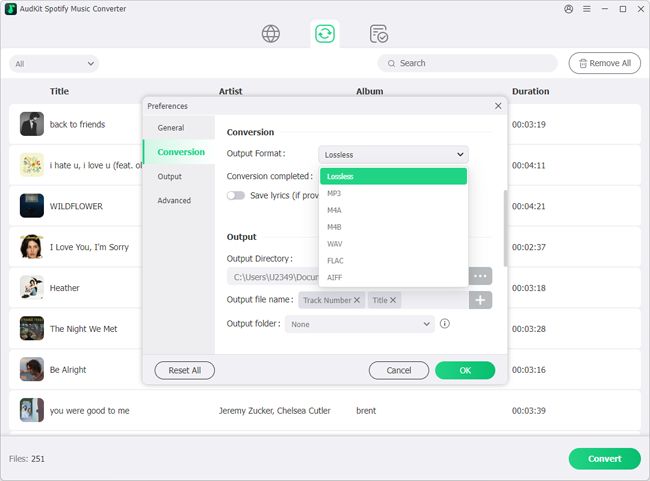
On the taskbar at the top of the interface, click “Menu” then “Preferences.” Here you can select your preferred music output format to either MP3, M4A, M4B, FLAC, WAV, or AAC. You can also edit basic audio parameters such as audio bit rate, sample rate, and channel. Note: For AudKit windows version users, we highly recommend that you change the default conversion speed from 5X to 1X for a more stable conversion process.
Step 3 Start download and conversion of Spotify songs
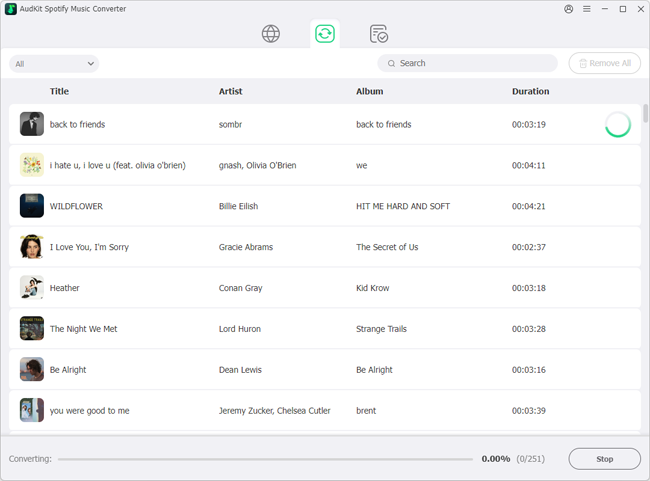
Once you have completed setting your audio parameters, click “Convert” at the bottom to begin the download and conversion process. All your downloaded songs will be automatically be saved in the local folder. Click the folder icon at the bottom to access your downloaded Spotify songs.
Step 4 Import Spotify songs to Ableton
Now that your music is saved locally, importing them into Ableton is incredibly straightforward:
- Launch Ableton Live and open a “New Live Set”.
- On the left-hand sidebar, navigate to “Places” and click “Add Folder”.
- Locate and select the folder where AudKit saved your converted Spotify songs.
- Once the folder appears in Ableton’s browser, simply drag and drop the tracks onto your audio timeline or session view slots.
Conclusion
While strict DRM policies make it impossible to directly link Spotify to Ableton Live, you don’t have to give up on mixing your favorite tracks. You can either use virtual audio cables for real-time recording, or, for a much cleaner and faster workflow, use the AudKit Spotify Music Converter.
AudKit allows you to bypass the hassle of manual recording, giving you high-quality, offline files ready to be dragged, dropped, chopped, and mastered within Ableton Live. Give it a try and elevate your DJing sets today!
Disclaimer: The methods discussed in this article are strictly for personal, educational, or DJing practice use. We do not encourage the piracy or commercial distribution of copyrighted music. Always respect the terms of service of streaming platforms and artists’ copyrights.

Elle Johnson
 Staff Editor
Elle Johnson has been working in the technology and music software field for over 5 years. She is dedicated to providing easy-to-use guides and effective tips to play music anywhere.