



💡 Quick Answer: How to Get Spotify into FL Studio
You cannot directly import Spotify songs into FL Studio because Spotify’s audio files are Ogg Vorbis format and protected by DRM encryption. To route Spotify music into your DAW, follow these steps:
- Step 1: Use a dedicated tool like AudKit Spotify Music Converter to remove DRM.
- Step 2: Convert the Spotify track to a DAW-friendly format like MP3 (320kbps) or WAV.
- Step 3: Drag and drop the converted, DRM-free audio file directly into your FL Studio Playlist or Channel Rack.
Spotify music in FL Studio? Sounds too good to be true. But, it isn’t. Fortunately, now you can route Spotify music to FL Studio without sacrificing fidelity or violating the terms of service.
For those who don’t know, FL Studio is a sophisticated digital audio workstation (DAW) that enables music creation, recording, editing, and production in any format. In continuous development for over 25 years, FL Studio has become the “fastest” route from head to speaker for many of the world’s leading DJs and music producers.
And not to mention, with over 100 million songs and audio available, Spotify has something for everyone, whether you want to listen to your beloved artists, uncover new genres, or create your own playlists. But how to get Spotify music into FL Studio? This article will explore the best way to do that.
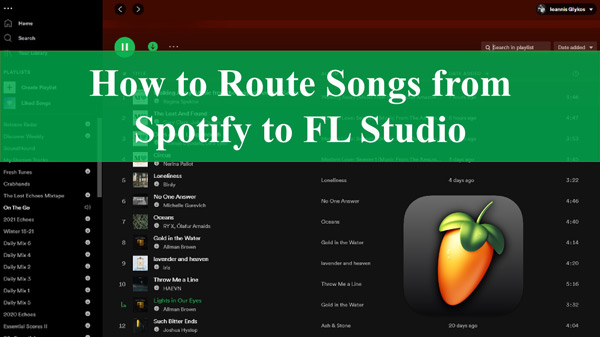
Part 1. How to Get Spotify into FL Studio – AudKit Spotify Music Converter
If you’re using FL Studio for music creation, hi-fi audio from Spotify is your ultimate need. Unfortunately though, you cannot directly use exclusive Spotify tracks in a DAW like FL Studio as the file format is not a FL Studio-supported one. As an alternative, a third-party audio converting tool can do the work for you.
Not sure where to find a reliable audio converter? We have you covered, AudKit Spotify Music Converter is your best bet!
Using AudKit Spotify Music Converter, you can easily import Spotify tracks into FL Studio and use them in your music videos. This professional tool converts Spotify music into MP3 format and WAV, M4A, and M4B, all of which are widely used audio formats. With an impressive conversion speed of 5X or even quicker, this efficient Spotify downloader allows you to load up to 100 tracks simultaneously and convert them in no time.
Not just that, The AudKit converter is equipped with cutting-edge converting technology allowing it to maintain 100% lossless audio quality from original music. Furthermore, it guarantees that all the original information of each Spotify music, including ID3 tags, is preserved in the converted files, for easy navigation of your local Spotify music collection.
Main Features of AudKit Spotify Music Downloader
- Export exclusive Spotify music as MP3, FLAC, WAV, AAC, and more
- Preserve the original audio quality and track info of Spotify tracks
- Swiftly convert Spotify tracks offline with 5X speed
- Widely use Spotify songs on other devices without ads
To understand how to download songs for FL Studio Spotify, follow the steps below:
Step 1 Add your favourite Spotify songs to AudKit converter
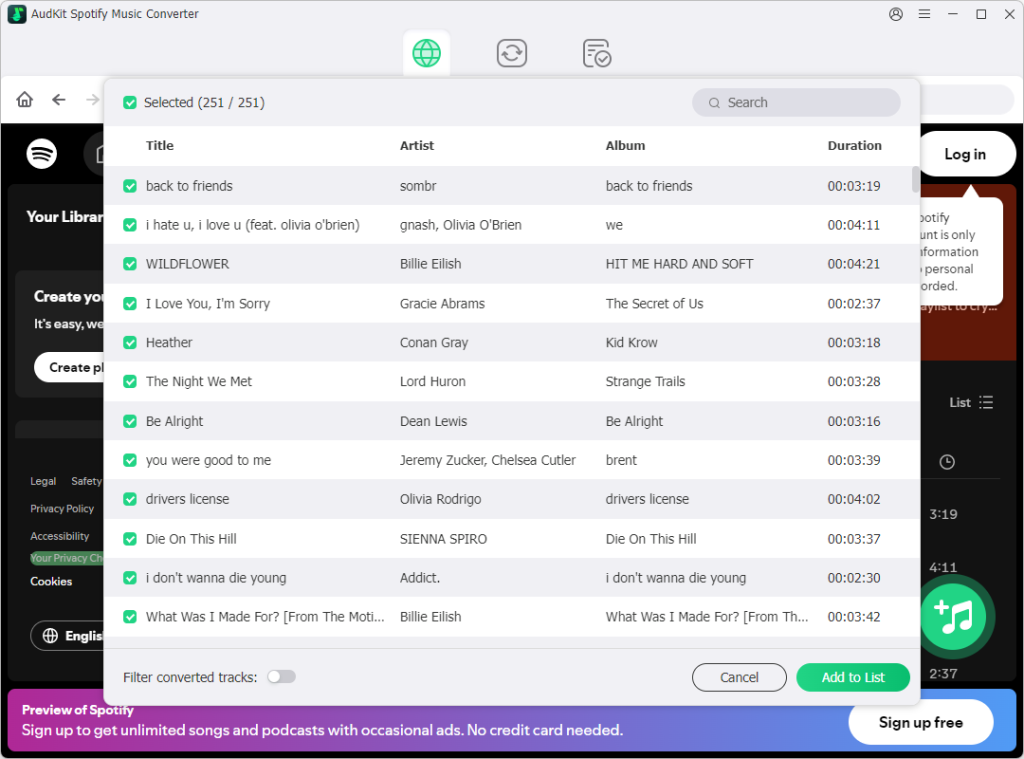
First and foremost, download and launch AudKit Spotify Music Converter on your device. On the Spotify app, browse and pick music, albums, or playlists you want to download. Right-click the selected music, tap “Share“, and then “Copy Song Link“. Then, on the AudKit text bar, paste the URL into the search field. To import it, click the “+” button.
Step 2 Customize Spotify audio output settings
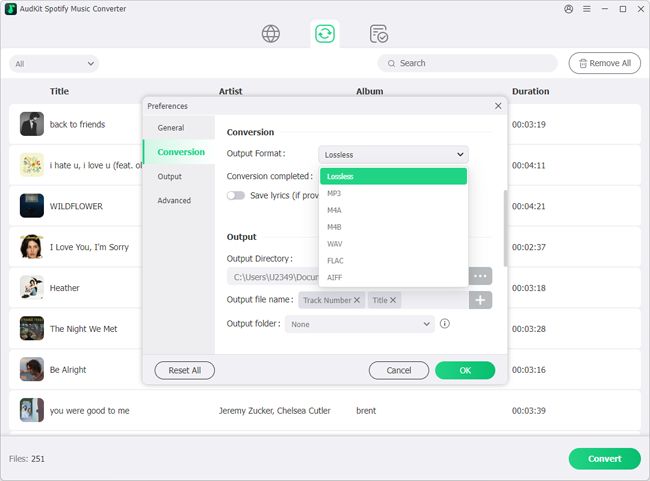
As the FL Studio supports audio like MP3 and WAV, you will need to change the audio formats then. Navigate to the main taskbar of the AudKit application and open “Menu” > “Preferences“. In the “Convert” tab, select the format to convert Spotify to MP3 or WAV, and customize settings such as channel, codec, bit rate, sample rate, etc. Then click “OK“.
Step 3 Get Spotify as MP3/WAV files for FL Studio
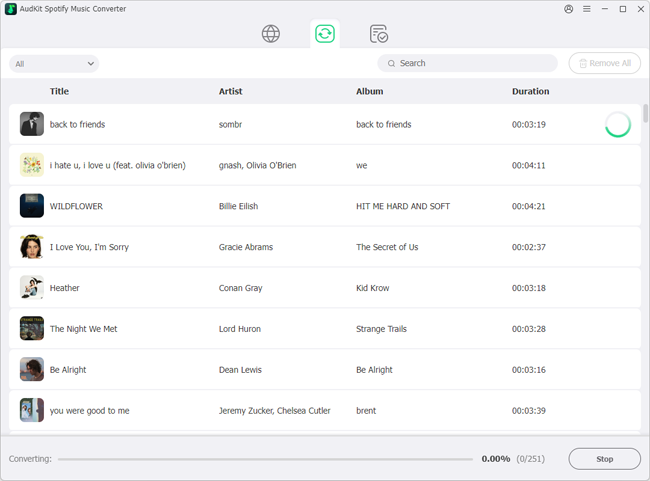
Once all the settings are done, click on the “Convert” button to begin converting the Spotify songs. When the process completes they will be automatically saved to the selected folder on your PC. Simply click on the “folder” icon on the AudKit converter to open the folder if you need.
Part 2. How to Import Songs into FL Studio from Spotify
Now that you have high-quality, free MP3 or WAV files saved on your computer, routing them into FL Studio is incredibly simple. You can use either of these two methods:
Here are the steps on how to use Spotify songs on FL Studio:
Method 1. Drag and Drop into the Playlist (Fastest)
The compositions can then be dragged and dropped into the FL Studio interface. Follow these steps.
Step 1. Launch the FL Studio app on your computer.
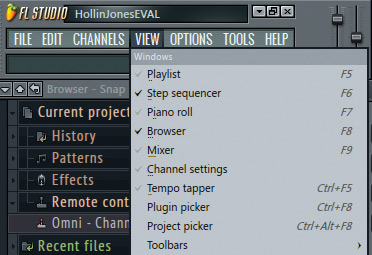
Step 2. Navigate to the top menu and click View > Playlist to open your main arrangement window.
Step 3. Open the local folder on your computer where your converted Spotify files are saved.
Step 4. Simply drag and drop the desired audio file directly onto a blank track in the FL Studio Playlist.
Step 5. You can now chop, reverse, pitch-shift, and mix the audio sample just like any other sound!
Method 2. Import via the Channel Rack Audio Clip
Step 1. Open FL Studio and open the Channel Rack.
Step 2. Click the “+” (Add one) button at the bottom of the rack and select Audio clip.
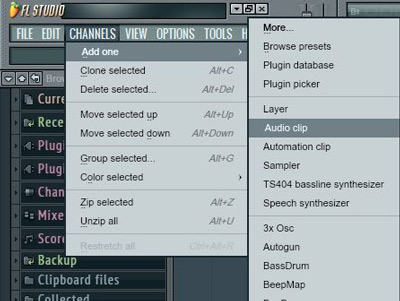
Step 3. Click on the newly created Audio clip in the Channel Rack to open its Sampler settings window.
Step 4. Click the Folder icon (Load sample) inside the Sampler window.
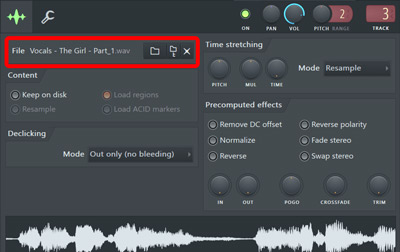
Step 5. Locate your converted Spotify MP3/WAV file from your hard drive and click Open to import it.
Part 3. FAQs About Routing Songs from Spotify to FL Studio
If you are still wondering about how to connect your Spotify library to your FL Studio workflow, here are the answers to the most commonly asked questions by music producers.
1. Can I use Edison to record Spotify directly into FL Studio?
Yes, you can route your computer’s internal audio into FL Studio’s Edison plugin using a virtual audio cable or FL Studio ASIO. However, this method records in real-time (1X speed) and can accidentally capture system notifications or background noises. Using a dedicated tool like the AudKit Spotify Music Converter is much more efficient, as it downloads entire playlists at 5X speed while preserving the original, lossless audio quality.
2. What is the best audio format to convert Spotify to for FL Studio?
FL Studio supports various audio formats, including WAV, MP3, FLAC, and standard OGG. For music production, it is highly recommended to convert Spotify tracks to uncompressed WAV or MP3 at 320kbps. WAV files provide the highest fidelity for chopping and stretching samples, ensuring your mix doesn’t suffer from muddy frequencies or digital artifacts.
3. Is it legal to sample Spotify songs in my FL Studio beats?
Converting and importing Spotify songs into your DAW is perfectly fine for personal, offline listening, and educational practice (such as learning how to structure a beat or practicing your mixing skills). However, if you plan to release a beat that contains uncleared Spotify samples for commercial use (like uploading to Apple Music or selling on Beatstars), you must obtain legal sample clearance from the original copyright holders to avoid copyright infringement.
Part 4. Wrapping Up
As seen above, you can easily import tracks from Spotify into FL Studio by following simple steps with the two methods. However, before doing that, you will need to concern about the FL Studio Spotify audio incompatibility. You need to convert music from Spotify to a format that is compatible with the DAW.
And the AudKit Spotify downloader, AudKit Spotify Music Converter is a more dependable and user-friendly option for this purpose. It lets you download Spotify music in MP3, WAV, FLAC, or any other popular format with the best quality.

Andrew Rowley
 Staff Editor
Andrew Rowley has over 10 years of writing experience and is good at writing in audio technology and audio converter software. He can provide high-quality articles to help streaming music lovers explore music better.