





Quick Answer
- Before you try anything, make sure both your Spotify-playing device and the target speaker/TV are on the same Wi-Fi network and restart the Spotify app.
- If Spotify Connect keeps dropping or won’t discover devices, updating your firmware, swapping DNS, or temporarily disabling your firewall often clears the blockage.
- When Connect remains stubbornly broken, downloading your playlists offline with a dedicated converter is a reliable workaround. For that, AudKit Spotify Music Converter is our top pick because it preserves original quality and works without a Premium subscription.
Spotify Connect is a great feature that lets you control your music playback on multiple devices. However, sometimes Spotify Connect can stop working for no apparent reason. And you have no idea why Spotify not connecting to devices. Is the Spotify Connect not working issue vexing? You’re not alone.
It’s our aim to help you resolve the Spotify not connecting problem. In this article, we offer 10 practical solutions that are all worth a shot. You can follow the methods one by one to troubleshoot. Happy listening!
- Solution 1. Change to a Stable Internet Connection
- Solution 2. Restart Spotify and Your Device
- Solution 3. Reinstall Spotify
- Solution 4. Update All Your Firmware
- Solution 5. Exchange DNS Server
- Solution 6. Disable Your Firewall
- Solution 7. Remove Spotify Account and Add it Again
- Solution 8. Test Your Audio
- Solution 9. Contact Spotify Support
- Solution 10. Play Spotify without Spotify Connect
Solution 1. Change to a Stable Internet Connection
Spotify Connect depends heavily on a stable local network. If your phone is on mobile data while your speaker is on Wi‑Fi, they’ll never find each other.
Step 1. Disable your current connection — turn off Wi‑Fi if you’re using it or turn off mobile data.
Step 2. Switch all involved devices (phone, tablet, speaker, TV) to the same Wi‑Fi network.
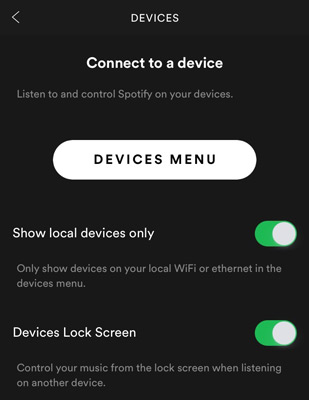
Step 3. Open Spotify, tap the Settings gear, then select Devices.
Step 4. Pick your target device from the list and see whether it connects.
If the list is empty even now, restart your router — a quick power cycle can resolve plenty of “invisible device” bugs.
Solution 2. Restart Spotify and Your Device
Temporary glitches in the Spotify app or the operating system often break the handshake between devices. A classic restart can flush those hiccups.
- On Android: Swipe Spotify upward from the multitasking tray to close it completely.
- On iOS: Double-click the Home button (or swipe up from the bottom on Face‑ID models) and swipe Spotify away.
Reopen the app and try Connect again.
If that doesn’t help, restart the device itself. Hold down the Power button, select Restart, and test again as soon as the phone or tablet boots up. Many Sonos and Alexa users find this one‑two combo fixes Spotify not connecting to Sonos instantly.
Solution 3. Reinstall Spotify
A corrupted cache can interfere with device discovery. The cleanest way to flush it is a full reinstallation.
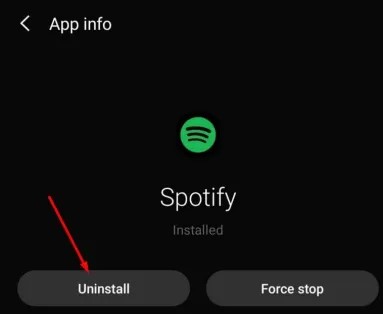
Step 1. Uninstall Spotify from your device.
Step 2. Download the latest version from your device’s official app store (Play Store or App Store).
Step 3. Install the app, log in with your credentials, and check if devices appear.
Before uninstalling, note that any downloaded offline content will be wiped. If you rely on downloads, you might want to save your favorite playlists as local files first — a task covered in Solution 10.
Solution 4. Update All Your Firmware
Spotify regularly optimizes Connect for new hardware, but those improvements only land on your device if its firmware is current. A stale OS on your speaker or TV is a notorious cause of Spotify not connecting to TV or wireless speakers.
Here’s how to update the most common targets:
Amazon Echo: Open the Alexa app → Settings → Device Settings → select your device → Software Updates → Check for Updates. This usually resolves Spotify not connecting to Alexa.
Sonos: Open the Sonos app → Settings → System Updates → Update Now. Once done, try to play Spotify through Sonos again.
Roku TV: Navigate to Settings → System → About → Check for Updates.
Solution 5. Exchange DNS Server
A sluggish or ISP‑mandated DNS server can slow down Spotify’s device registration. Switching to a fast public DNS often cuts through the lag.
On Windows/Mac: Go to your Wi‑Fi or Ethernet settings, open the IPv4 properties, and replace the DNS server addresses with 8.8.8.8 and 8.8.4.4 (Google) or 1.1.1.1 (Cloudflare).
On Android/iOS: Long-press your Wi‑Fi network, tap Modify Network, and switch to static IP settings where you can enter the new DNS values.
If you’re using a VPN, disconnect it while testing Connect — some VPN providers route traffic in a way that hides local network devices.
Solution 6. Disable Your Firewall
Windows Firewall or third‑party security suites sometimes classify Spotify Connect traffic as unauthorized and block it silently.
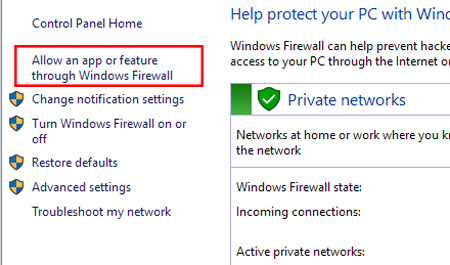
- Open Windows Security, click Firewall & network protection, then click Allow an app through firewall.
- Look for Spotify in the list and make sure both Private and Public checkboxes are checked.
- If Spotify isn’t listed, click Change settings → Allow another app → browse to Spotify’s executable and add it.
If the problem persists, temporarily disable your firewall (Windows Security → Firewall & network protection → toggle it off for the active network). Test Connect immediately — if it works, re‑enable the firewall and create a permanent exception. Never leave your system unprotected longer than necessary.
Solution 7. Remove Spotify Account and Add it Again
When your device’s login token becomes stale, Spotify may stubbornly refuse to pair. Removing the device from your account and logging in fresh often renews the link.
Step 1. Open Spotify on the device that won’t connect.
Step 2. Go to Settings → scroll to the bottom and tap Sign Out.
Step 3. Now visit the Spotify account page on a computer or mobile browser and navigate to Apps.
Step 4. Find the device you want to reset and click Remove Access.
Step 5. Open Spotify again, log in with your credentials, and check the Connect menu.
This method is particularly effective for devices that previously paired but suddenly stopped appearing.
Solution 8. Test Your Audio
If the Connect list shows your device but no sound comes out, the issue might not be the connection — it could be the audio output configuration.
Step 1. On your computer, launch Spotify and click Edit (Windows) or Spotify (Mac) → Preferences.
Step 2. Scroll to the Audio Output section under Advanced.
Step 3. From the Device drop‑down, select your intended speaker or headphones.
Step 4. Click Test. If you hear the chime, the path is correct.
Step 5. If you hear nothing, select a different output device and test again.
After you identify the working output, go back to the Spotify Connect screen and select the same device from the list. The two must be aligned.
Solution 9. Contact Spotify Support
If you’ve worked through every step above and still see “Spotify Connect not working,” the problem may be account‑specific or server‑side. Spotify’s in‑house team can diagnose what you can’t see.
Reach out through one of these channels:
- The Spotify Community Forum — search for your issue or start a new thread.
- Twitter (@SpotifyCares) — send a direct message with your device model and OS version.
- Facebook — message the official Spotify page.
When you contact them, mention which troubleshooting steps you’ve already taken so they can jump straight to deeper diagnostics.
Solution 10. Play Spotify without Spotify Connect
Sometimes the fastest fix is to bypass Connect entirely. By converting your Spotify tracks into local audio files, you can play them on any device — smart TV, car stereo, MP3 player, or USB drive — without relying on the Spotify app’s pairing process. This is also a solid fallback when you’re facing repeated Spotify not connecting to internet errors.
AudKit Spotify Music Converter is the tool we recommend for this job. It downloads Spotify songs, playlists, and albums directly to your computer in universal formats such as MP3, AAC, FLAC, and WAV. The conversion retains the original audio quality and preserves ID3 tags (title, artist, album art), so your offline library stays organized. Because the resulting files are DRM‑free, you can transfer them to any device you own — no Spotify Connect needed.
Main Features of AudKit Spotify Music Downloader
- Convert Spotify music to the specified folder on PC at 5X speed
- Losslessly export Spotify tracks in MP3, AAC, FLAC, and other files
- Keep Spotify music with its ID3 tags for better management
- Play Spotify on multiple devices without Spotify Connect
Steps to Download and Play Spotify on Other Devices without Using Spotify Connect
To use AudKit SpotiLab Music Converter, you first need to download and install it on your computer. You can choose from Mac to Windows versions. Then, follow the 3 steps below to convert and enjoy Spotify on other devices without Spotify Connect.
Step 1 Launch AudKit SpotiLab Music Converter
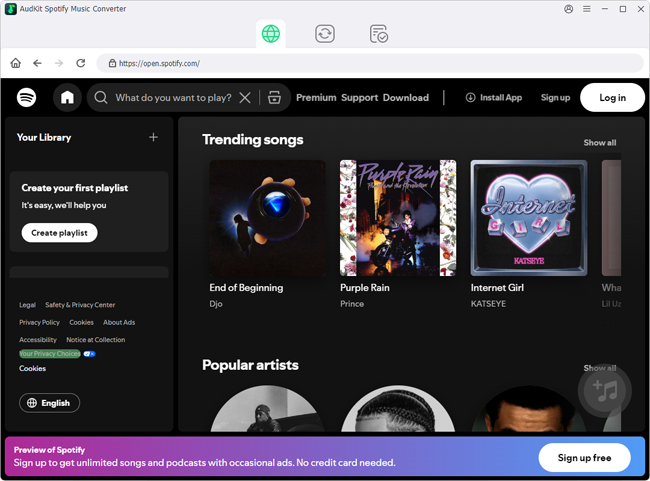
After installing AudKit SpotiLab Music Converter, start up the converter on your computer. The AudKit’s main interface and the Spotify app will pop up. Sign in to the AudKit and Spotify app to get ready for adding Spotify songs.
Step 2 Add Spotify playlists to the AudKit converter
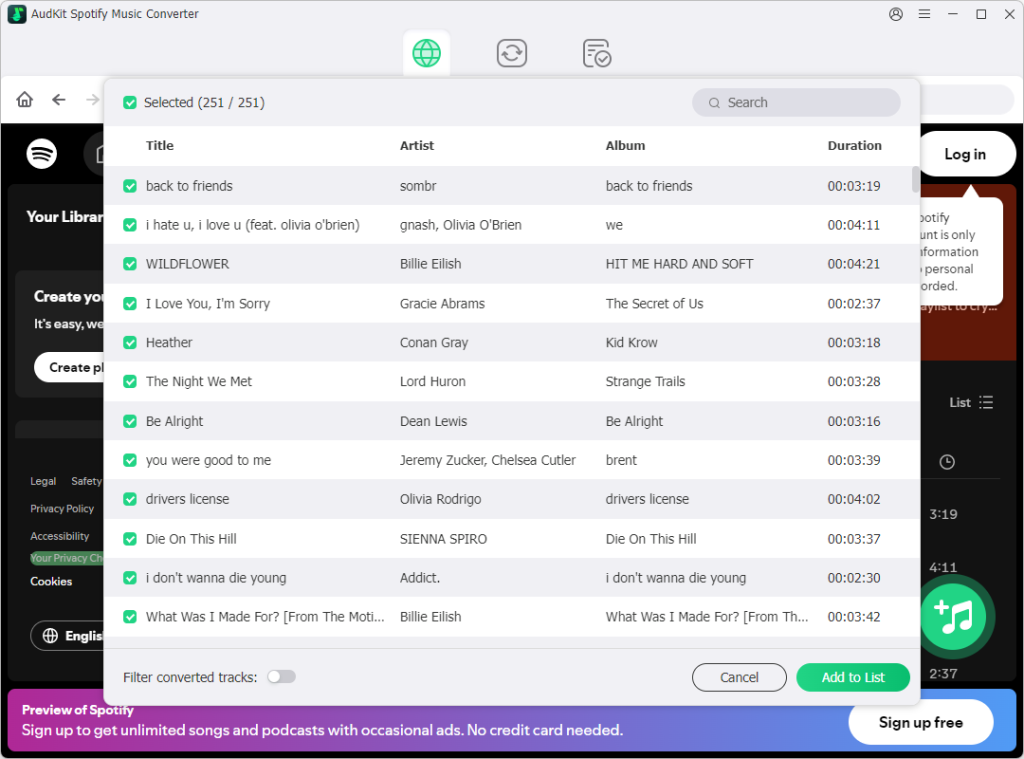
Go to the Spotify app and find the songs you want to download. Then, drag and drop them into the window of AudKit SpotiLab. Or you can copy the link of the Spotify song and put the link into the search bar, and then make a confirmation by pressing the “+” sign.
Step 3 Choose Spotify output format and export Spotify songs
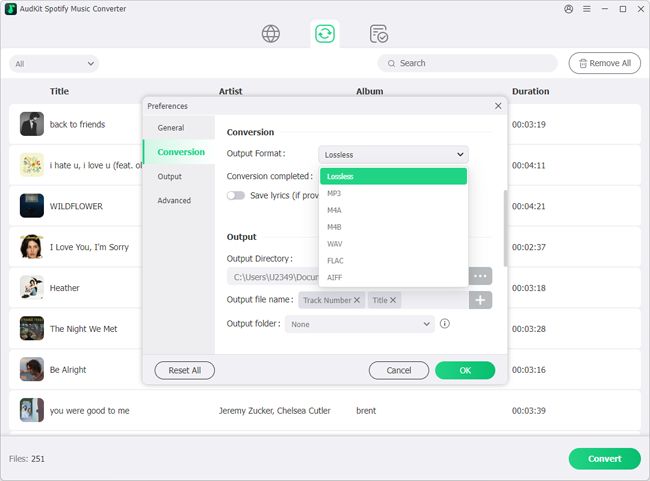
Click on the “Menu” icon in the top-right corner and select “Preferences“. You can choose your preferred output format, output quality, and output path in the new window. After saving the settings by tapping OK, click on the “Convert” button at the bottom task bar to start downloading Spotify offline as local files.
Once the conversion is done, you can find the downloaded Spotify songs in the output folder you set. Now, you can play Spotify anywhere even though Spotify Connect malfunctioned.
Frequently Asked Questions
Why does Spotify Connect keep disconnecting even on a strong network?
Frequent dropouts usually point to IP conflicts, router firewall rules, or interference on the 2.4 GHz band. Try assigning a static IP to your speaker, switching your phone and speaker to a 5 GHz network if available, and disabling any AP isolation setting in your router’s advanced Wi‑Fi options.
Can I still cast Spotify if my device isn’t showing up in the Connect list?
Yes, but you’ll need to eliminate the root cause first. Force‑close Spotify, restart your router, and check whether your speaker has been removed from your Spotify account (see Solution 7). If the speaker appears in the app but won’t play, test the audio output as described in Solution 8.
What’s the best workaround if all troubleshooting fails?
When Connect refuses to work despite every fix, downloading your Spotify library as local audio files is the most flexible alternative. AudKit Spotify Music Converter lets you save tracks in MP3, FLAC, and other open formats — once the files are on your computer, you can play them on any device without needing the Spotify app or a stable network connection.
Conclusion
With the solutions, we wish you now have no questions about “why is my Spotify not connecting to the Internet”. Hopefully, one of these solutions will help get you up and running again. If not, be sure to reach out to Spotify support for more help to fix Spotify Connect not working issue. Moreover, we have the best way for you to stream Spotify offline without Spotify Connect by AudKit Spotify Music Converter which is a tool you can get benefits from it to download Spotify without premium.

Andrew Rowley
 Staff Editor
Andrew Rowley has over 10 years of writing experience and is good at writing in audio technology and audio converter software. He can provide high-quality articles to help streaming music lovers explore music better.