





Quick Answer: How to Add Local Files to Spotify
Quick Answer: Enable Local Files in the Spotify desktop app, click Add a Source, pick the folder with your music, then download the synced playlist on your phone while on the same Wi-Fi — mobile sync requires Premium. The essentials:
- On computer: open Spotify → click your profile avatar → Settings → Local Files → turn on Show local audio files → Add a Source and choose the folder. Your tracks appear under Your Library → Local Files.
- On iPhone/Android: if the audio is already stored on your device, go to Settings → Local Files and turn on Show audio files from this device to see it in Your Library.
- Sync from desktop to phone: create a playlist with your local tracks on the desktop app, then on your phone — using the same account and Wi-Fi — open that playlist and tap Download (Premium required).
- If a track won’t show or play: check that it’s a supported format like MP3 or M4A (DRM-protected files won’t work) — or use a dedicated converter for Spotify-only songs.
CD rips, bootlegs, unreleased or region-locked tracks, and self-recorded demos rarely make it into Spotify’s catalog of 100+ million tracks and 5+ million podcasts. Spotify lets you stream music and save it for offline listening, and Premium users can go ad-free with unlimited skips.
Some of you have local music files that aren’t available on Spotify. The desktop Spotify app can detect these files, but sometimes Spotify can’t find certain music files or folders on your hard drive or external storage. If you’re facing this issue, follow this guide to learn how to add local files to Spotify.
This guide covers all three platforms. If the track you want isn’t a local file but a Spotify exclusive, the final tip shows how AudKit Spotify Music Converter turns it into a local file.
- Part 1. How to Add Local Files to Spotify on iPhone
- Part 2. How to Add Local Files to Spotify on Android
- Part 3. How to Add Local Files to Spotify on Computer
- Tip: How to Download Spotify Music as Local Files
Before You Start: What You Need to Add Local Files
Before you start, run through this quick checklist — skip any of these and local files will stay hidden on your phone or tablet:
- Use the Spotify desktop app (Windows, macOS, or Linux) first. The Web Player doesn’t support local files, so nothing you add in a browser will appear later.
- Sign in to the same Spotify account on every device. Local-file playlists are tied to your account, not to a specific device.
- Connect your phone and computer to the same Wi-Fi network. Spotify transfers local files between devices over Wi-Fi — mobile data won’t work.
- Skip DRM-protected files, such as old iTunes Store purchases or other copy-protected audio. Spotify filters these out during the import process.
One more rule to remember: free accounts can play local files on desktop only. Syncing or downloading playlists that contain local tracks to your iPhone or Android requires a Premium subscription.
Part 1. How Do I Add Local Files to Spotify on iPhone
Create a playlist on your desktop app first: click New Playlist, name it, then add the local tracks you want to sync (via Settings → Local Files → Add a Source). This step is essential because iPhone sync works through playlist downloads, not direct uploads.
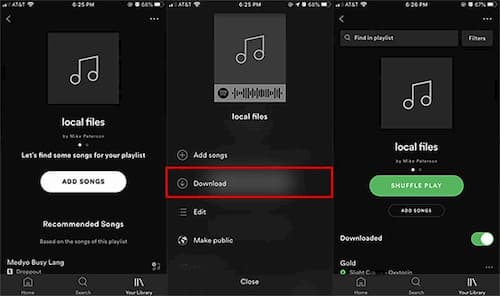
Then on your iPhone:
- Go back to your library, open the playlist you created in the first step, and tap the Download toggle. Note: syncing local files to your iPhone requires a Spotify Premium subscription.
- Connect your iPhone and computer to the same Wi-Fi network.
- Open Spotify on your iPhone and go to Settings → Local Files.
- Turn on “Sync from desktop” — this allows your phone to see playlists that contain local files from your computer.
If you want Spotify to show audio files already stored on your iPhone itself — such as songs imported through iTunes or the Files app — enable “Show audio files from this device” in the same Local Files settings. Keep those files in Files → On My iPhone (not iCloud Drive) so Spotify can scan them reliably; files stored in iCloud may not appear or may download slowly.
Part 2. How to Add Local Files to Spotify on Android
Spotify on Android can now read audio files stored directly on your phone — no computer involved. Make this direct path your primary flow:
- Go to Your Library → Local Files — every recognized audio file on your device shows up here automatically.
- Open the Spotify app and tap the Settings gear icon in the top-right corner of the Home screen.
- Tap Local Files.
- Toggle on Show audio files from this device.
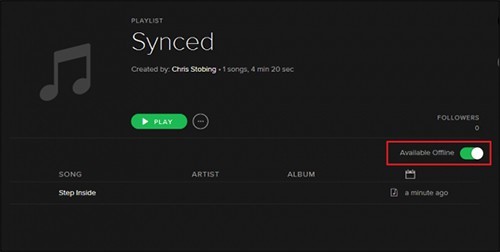
Two quick notes: Spotify scans broadly, so keep voice memos, recordings, and ringtones out of your music folder to avoid clutter. If tracks on an SD card don’t appear, move them to internal storage and restart the app.
Prefer syncing from your computer? That route still works — add the files to a playlist in the desktop app, sign in with the same account on Android, keep both devices on the same Wi-Fi, then tap Download on the playlist. Note that syncing local files to mobile this way requires a Premium subscription. And if the songs you want aren’t local files at all but Spotify-exclusive, convert them to local audio first with a converter like AudKit Spotify Music Converter, then follow the steps above.
Part 3. How to Add Local Files to Spotify on Computer
Spotify allows you to add local music files, which are in MP3 or MP4 format, unless it contains the video. To know how to add local files to a Spotify playlist on the computer, follow our below steps:
Step 1: Open your Spotify app on your PC or Mac computer. Then log in to your Spotify account.
Step 2: If you are a Mac user, go to the Spotify menu and choose ‘Preferences.’ And if you are a Windows user, you can find it under the ‘Edit’ option.
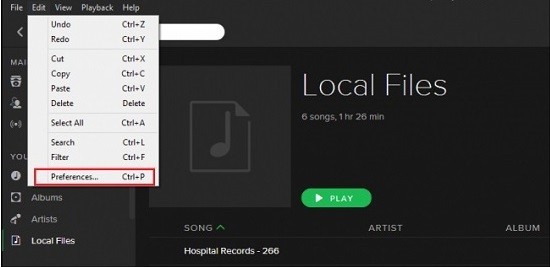
Step 3: Scroll down to the newly appeared windows to add local files. Choose the ‘Add a SOURCE’ option and then choose your target music folder, which includes local music files. It will be added to the Spotify library for a while.
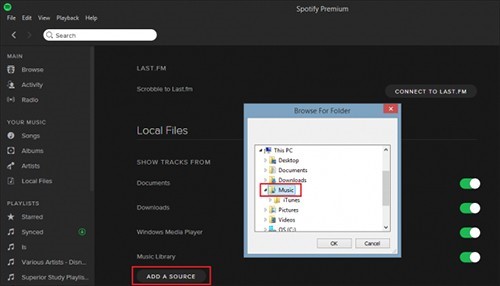
Step 4: Now you can see your uploaded songs in the Local File’s option at the left sidebar of the main interface of the Spotify app.
Tip: How to Download Spotify Music as Local Files
As you have learned to get local files to Spotify from Android and iPhone, now we will introduce you how to download Spotify music as local files. What you need an additional app called AudKit Spotify Music Converter, which will allow you to convert Spotify music to MP3 and save them as local files with lossless quality. You can also get your favorite Spotify playlists, podcasts, or radios in any of the output formats such as M4A, M4B, WAV, or FLAC with 5X conversion speed.
With its most advanced features, Audkit Spotify Music Converter also gives you an option to edit the ID3 tags such as artists, albums, titles, or track numbers. You can manage and organize the local music library by viewing the ID3 tags.
Main Features of AudKit Spotify Music Converter
- Available to Spotify songs, playlists, podcasts, etc.
- Customize output audio formats and ID3 tags
- Maintain lossless sound quality after conversion
- Offline listen to Spotify music without Premium
Please Download the AudKit Spotify Music Converter for your Windows or Mac computer. After downloading, launch the app on your device. Now Register to the app by going to the menu and then click ‘Register.’ Then activate the full version by giving your licensed email and registration code.
Here is our guide for getting the Spotify music as local files.
Step 1 Import Spotify songs
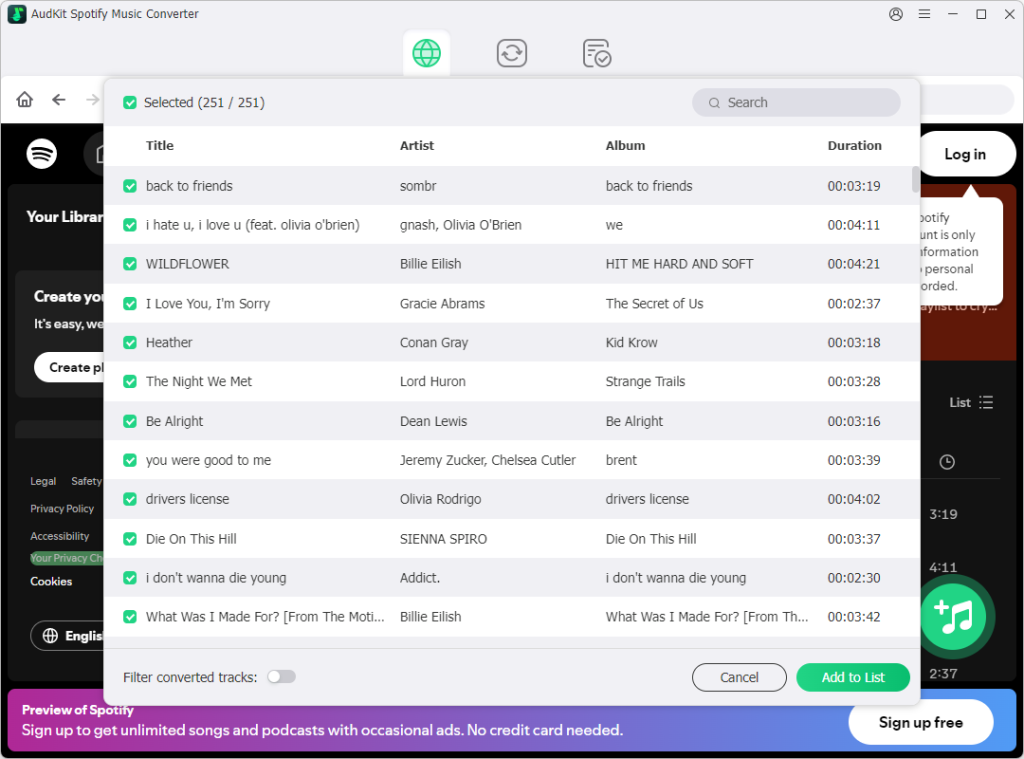
Once you have got the full version, you can add Spotify songs to the convert. Choose the required song, and then right-click on it. Click on ‘Share’ and then ‘Copy Song Link.’ Paste the link on the main window of the converter. You can also drag and drop the songs into the converter.
Step 2 Reset Spotify output settings
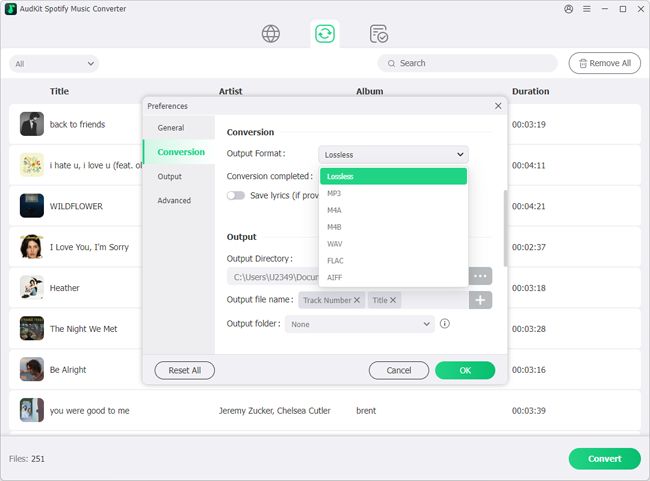
Go to the menu and then ‘ Preferences’ to format the output settings. Choose the format from the drop-down menu as MP3, AAC, FLAC, M4A, or M4B. Also, you can edit the sample rate, bit rate, etc.
Step 3 Download and convert Spotify songs
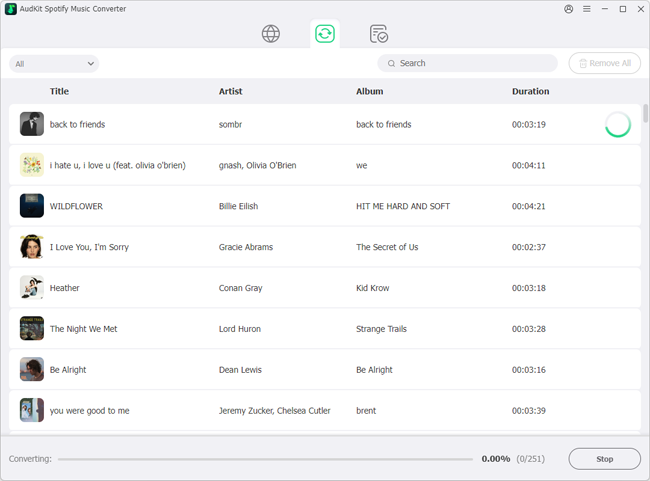
Choose the ‘Convert’ button to start the conversion of Spotify songs to music files. You will get your required Spotify music files in your chosen output format, which are saved in the local folder. Now you can download music from Spotify to your computer as local music files. Then you can transfer and enjoy them on any device.
FAQ: Adding Local Files to Spotify
Quick answers to the most common local-files questions:
Do I need Spotify Premium to add local files to my phone?
Yes — syncing or downloading local tracks to your iPhone or Android device requires a Premium subscription. Free accounts can still play local files in the desktop app.
Why won’t my WAV or FLAC files show up in Spotify?
Spotify only reads MP3, M4A/MP4, and unprotected AAC files. Lossless formats like WAV, FLAC, and ALAC are skipped automatically, so convert them to MP3 (320 kbps recommended) first, then re-add the folder as a source.
Why are my local tracks grayed out or unplayable?
The source file was usually moved, renamed, or deleted from your computer, or the file carries DRM protection. Re-add the correct folder in Settings → Local Files, then re-download the playlist on your phone.
Can I share a playlist that contains local files with friends?
No — Spotify blocks local-file tracks from shared and collaborative playlists for copyright reasons. Friends who open your playlist will see those songs grayed out or skipped.
How do I save Spotify-only songs as local files?
Spotify doesn’t offer an official export option, so the practical workaround is conversion. The Tip section above shows how AudKit Spotify Music Converter saves Spotify-only tracks as local MP3 or AAC files you can keep on any device.
Conclusion
We have concluded this article on the solution for how to add local files to Spotify. You can get your local files on Spotify from an Android phone or iPhone by our solution guide. Also, the AudKit Spotify Music Converter provides you high-quality Spotify music as local files. So, you can enjoy it at ease!

Elle Johnson
 Staff Editor
Elle Johnson has been working in the technology and music software field for over 5 years. She is dedicated to providing easy-to-use guides and effective tips to play music anywhere.
1 reply on “How to Add Local Files to Spotify on iPhone / Android / Computer”
However, Spotify is indiscriminate when adding local files. This also includes Voice messages, The one sided recordings of phone calls, Voice memos, Meeting recordings, reminder recordings, list recordings, Theme music, sounds, prompts and help from other android applications, ring-tones, notifications from other applications and games, etc. None of which belongs in a music library. AND could amount useless static that should not be there. At the very least they could just add an option for just ONE folder which could be on a removable device.